Open Source, Closed Exit
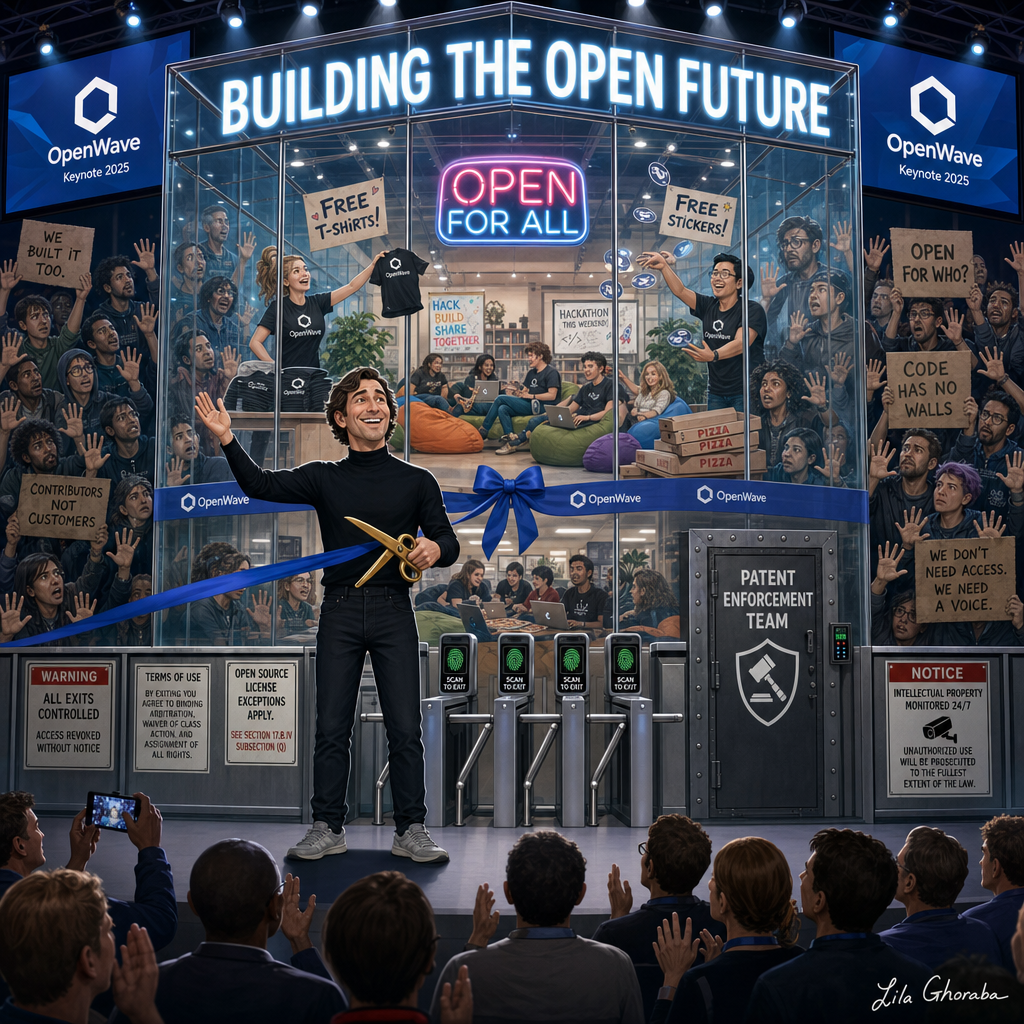
The cartoon mocks companies that market themselves as champions of openness and community while using legal barriers, ownership controls, and corporate gatekeeping to trap, exploit, or exclude the very people who create that value. It targets “open” as branding rather than principle.
A sleek keynote stage at a glitzy tech conference: center stage, a smiling startup founder in black turtleneck theatrically cuts a ribbon to unveil a transparent glass pavilion labeled in huge glowing letters, “BUILDING THE OPEN FUTURE.” The pavilion is marketed like a welcoming community space—beanbags, hackathon posters, pizza boxes, and a neon sign reading “OPEN FOR ALL.” But the joke lands in the architecture: every visible exit from the glass hub is blocked by fingerprint scanners, turnstiles, legal warning placards, and one heavy door marked “PATENT ENFORCEMENT TEAM.” Inside the pavilion, branded staff toss free T-shirts and stickers to developers, while outside the glass, the actual volunteer coders and contributors are pressed up against the walls, excluded like spectators at an aquarium. The founder waves proudly to the crowd, oblivious to the contradiction between open rhetoric and locked-down control.