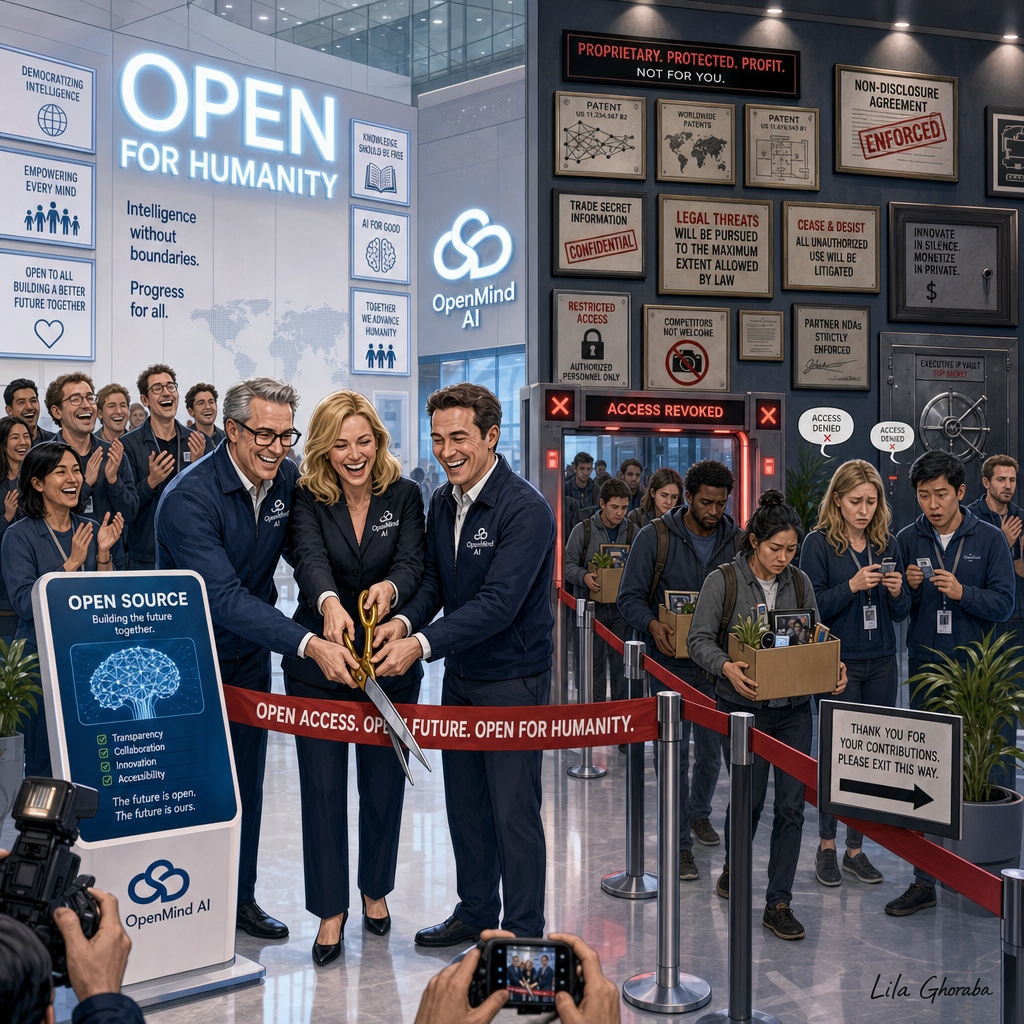
Open Source, Locked Exit
The cartoon mocks the tech industry's habit of branding itself as a benevolent force for openness and human progress while hoarding control, weaponizing intellectual property, and discarding workers. The joke is that the company’s grand public 'opening' is literally staged on top of a private shutdo
A single-panel cartoon set in the pristine lobby of a futuristic AI company. In the foreground, smiling executives in branded suits ceremonially cut a ribbon beneath a glowing slogan wall that reads OPEN FOR HUMANITY. They pose for cameras beside a sleek demo kiosk labeled OPEN SOURCE. But the ribbon they are cutting is actually attached to a waist-high barrier guiding employees out of the building. In the background, a line of recently fired workers carrying cardboard boxes shuffles through a turnstile stamped ACCESS REVOKED, while a security scanner flashes red. The back wall is split visually: one half covered in inspirational phrases about democratizing intelligence, the other packed with framed patents, NDAs, legal threat notices, and restricted-access signs. A few of the applauding staff realize too late that their own ID badges no longer work.
More in Technology
 Technology
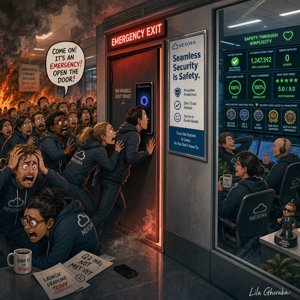
Emergency Exit Through Facial Recognition
The cartoon mocks the tech industry’s habit of treating optimization, surveillance, and compliance metrics as more real than human need—showing a system designed for safety becoming a deadly obstacle because institutional faith in frictionless security overrides common sense.
by Lila Ghoraba
 Technology
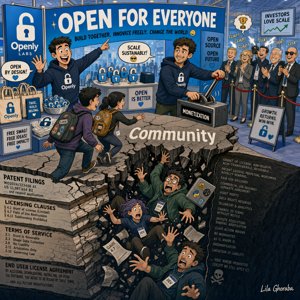
Open Source, Closed Exit
The cartoon targets performative openness in tech: companies market themselves as community-friendly and accessible, but use legal and financial mechanisms to convert shared participation into private control once value appears.
by Lila Ghoraba
 Technology
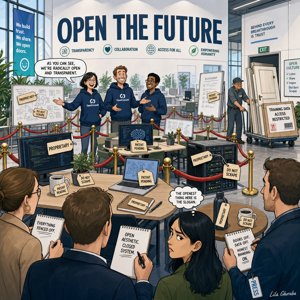
Open Office, Closed Future
The cartoon mocks tech companies that market themselves as champions of openness, collaboration, and the public good while aggressively locking down data, models, and methods the moment real access is at stake. Their openness is architectural and aesthetic, not substantive.
by Lila Ghoraba