Open Office, Closed Future
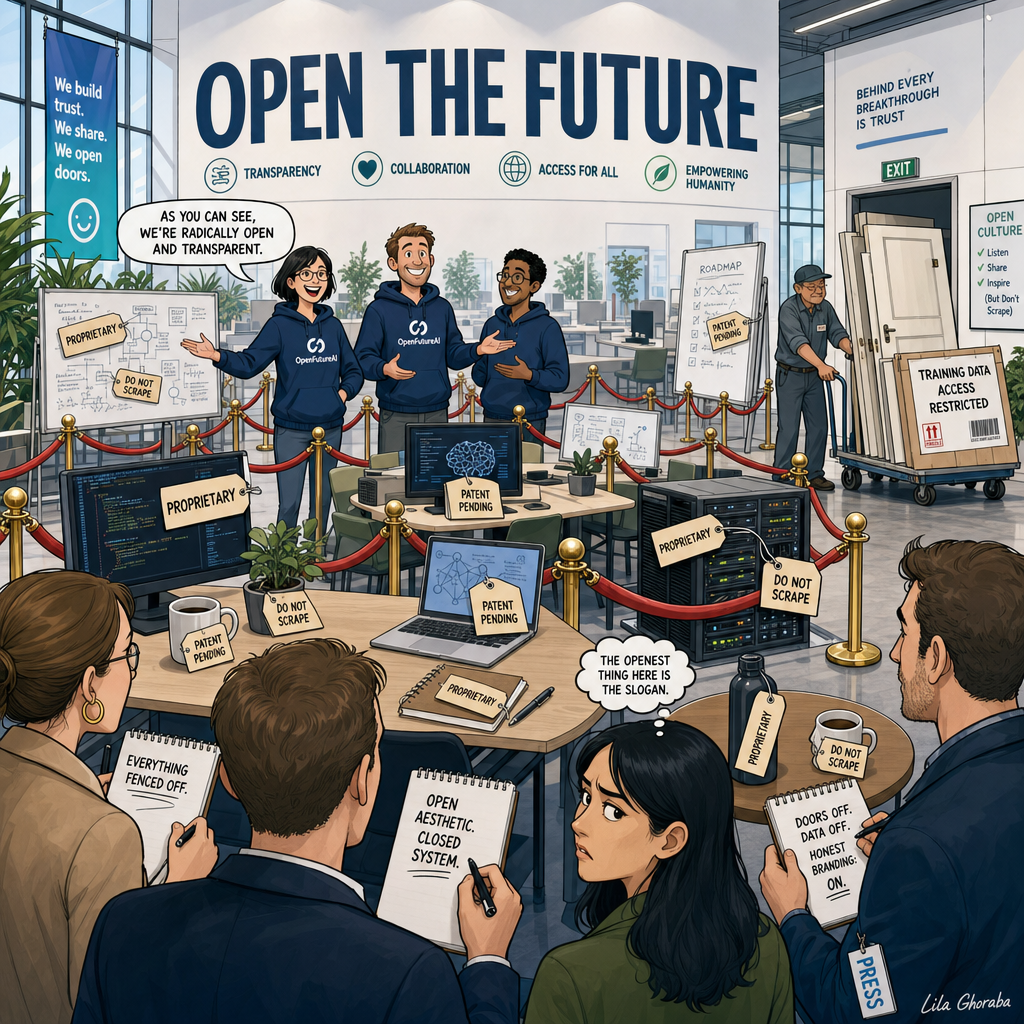
The cartoon mocks tech companies that market themselves as champions of openness, collaboration, and the public good while aggressively locking down data, models, and methods the moment real access is at stake. Their openness is architectural and aesthetic, not substantive.
A bright, minimalist AI startup headquarters is giving a press tour beneath a huge aspirational wall mural that says “OPEN THE FUTURE.” Smiling founders in matching hoodies gesture proudly around an open-plan office full of glass walls, communal tables, and trendy transparency branding. But the actual workspaces are absurdly cordoned off: each desk sits inside a tiny velvet-rope enclosure with brass stanchions, and monitors, whiteboards, and even coffee mugs carry little tags reading “Patent Pending,” “Proprietary,” or “Do Not Scrape.” In the background, a janitor quietly loads the office doors onto a cart; each removed door has a shipping tag that reads “Training Data Access Restricted.” Reporters take notes, noticing that everything branded as open is literally protected, gated, or being wheeled away.
More in Technology
 Technology
Emergency Exit Through Facial Recognition
The cartoon mocks the tech industry’s habit of treating optimization, surveillance, and compliance metrics as more real than human need—showing a system designed for safety becoming a deadly obstacle because institutional faith in frictionless security overrides common sense.
by Lila Ghoraba
 Technology
Open Source, Closed Exit
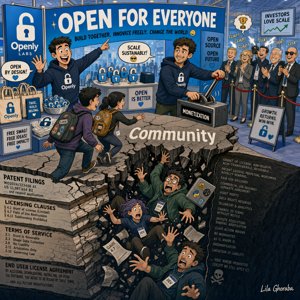
The cartoon targets performative openness in tech: companies market themselves as community-friendly and accessible, but use legal and financial mechanisms to convert shared participation into private control once value appears.
by Lila Ghoraba
 Technology
Open Office, Locked Exit
The cartoon mocks tech-sector hypocrisy: leaders sell ‘openness,’ ‘innovation,’ and ‘the future’ as aspirational branding while using AI as a polished instrument of disposability and labor control. The joke is that the company’s most successful automation is not creativity or progress, but locking w
by Lila Ghoraba