Green AI, Red Hot River
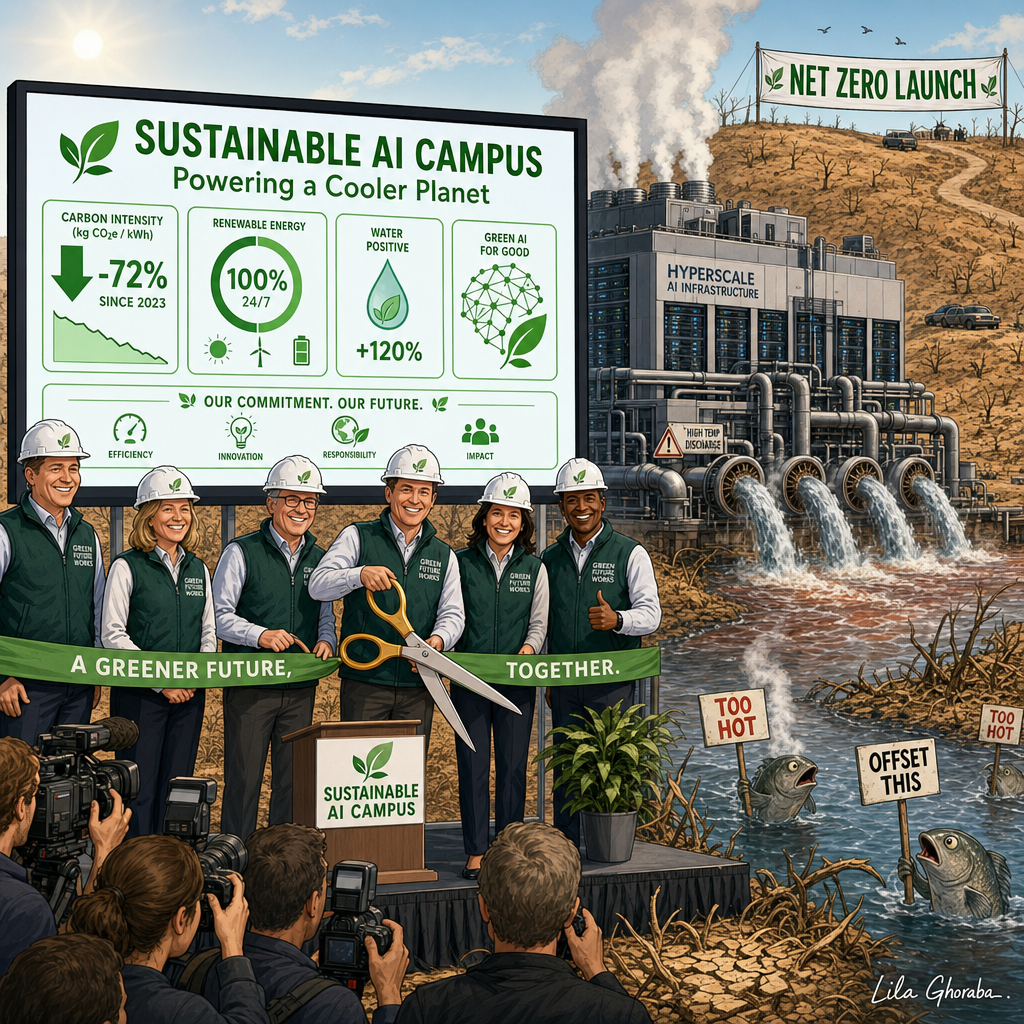
Corporate climate branding turns environmental harm into a photo-op: the cartoon mocks how tech companies market AI as a sustainability breakthrough while hiding the energy, water, and heat costs of the physical infrastructure making it possible.
An editorial cartoon set at a glossy ribbon-cutting for a new 'Sustainable AI Campus.' In the foreground, executives in matching fleece vests and hard hats grin for cameras as they hold oversized ceremonial scissors. Behind them, a giant presentation screen glows with cheerful eco-graphics: leafy dashboards, falling carbon arrows, smiling wind-turbine icons, and the slogan 'Powering a Cooler Planet.' But the stage is positioned beside the actual facility, where thick cooling pipes from the data center pour visibly steaming water into a river. Fish at the waterline hold tiny protest placards like 'TOO HOT' and 'OFFSET THIS,' while dead reeds curl at the banks. In the background, a browned, heat-scorched hillside carries a polished event banner reading 'NET ZERO LAUNCH.' The executives stay carefully framed for the photo so the green branding dominates, while the environmental damage is impossible for the viewer to miss.
More in Technology
 Technology
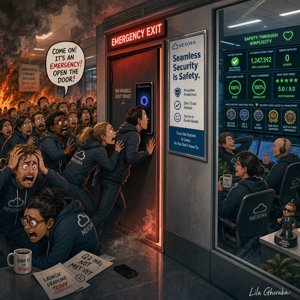
Emergency Exit Through Facial Recognition
The cartoon mocks the tech industry’s habit of treating optimization, surveillance, and compliance metrics as more real than human need—showing a system designed for safety becoming a deadly obstacle because institutional faith in frictionless security overrides common sense.
by Lila Ghoraba
 Technology
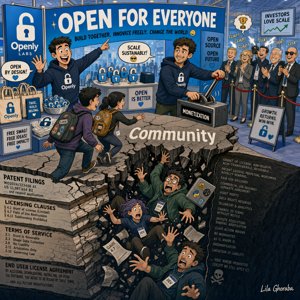
Open Source, Closed Exit
The cartoon targets performative openness in tech: companies market themselves as community-friendly and accessible, but use legal and financial mechanisms to convert shared participation into private control once value appears.
by Lila Ghoraba
 Technology
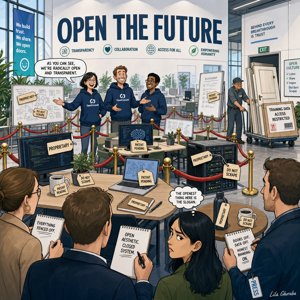
Open Office, Closed Future
The cartoon mocks tech companies that market themselves as champions of openness, collaboration, and the public good while aggressively locking down data, models, and methods the moment real access is at stake. Their openness is architectural and aesthetic, not substantive.
by Lila Ghoraba