Open Office, Closed Future
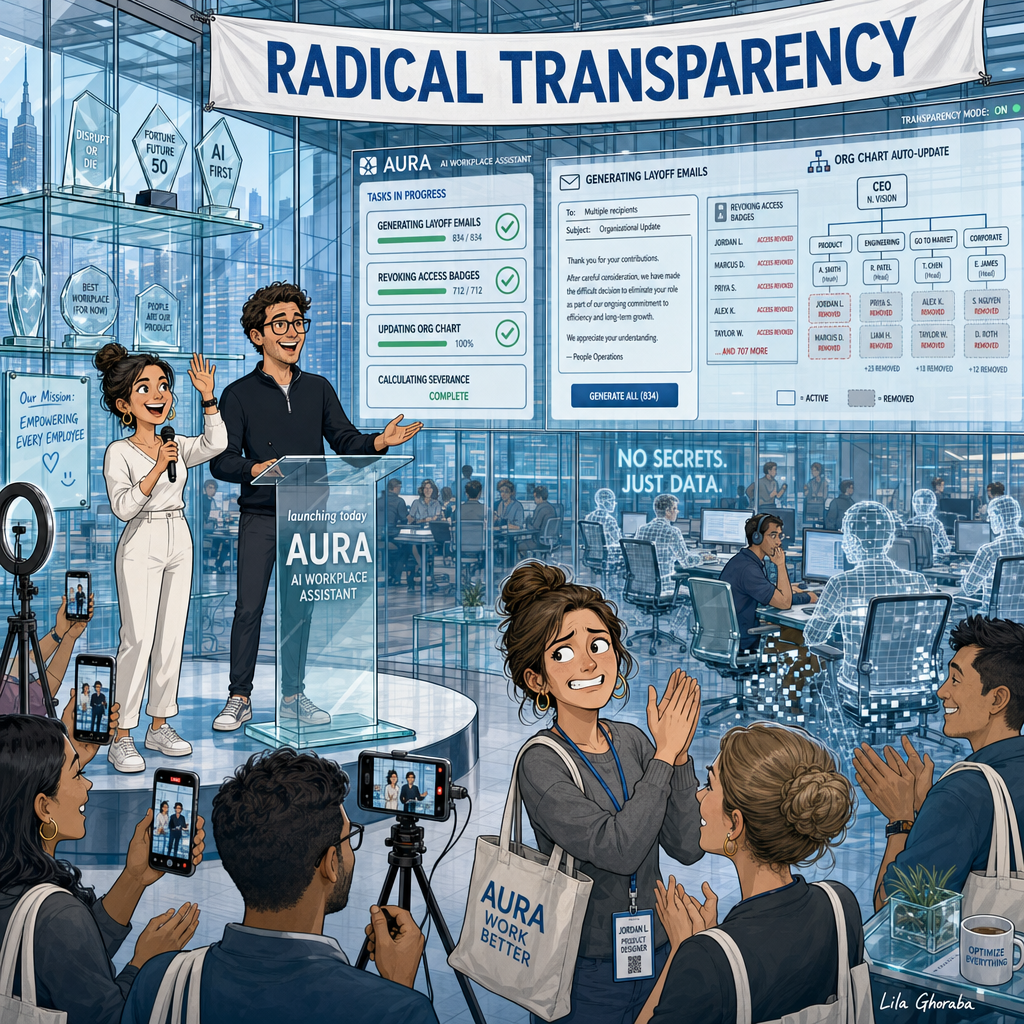
The cartoon mocks corporate tech rhetoric that treats visibility as virtue while using 'openness' branding to cosmetically soften automation-driven disposability. It satirizes leaders who are proudly transparent about process, product, and culture right up until that transparency exposes that employ
A single-panel cartoon set inside an ultra-modern AI startup made almost entirely of glass: glass conference walls, glass whiteboards, glass trophies, and a huge slogan banner reading 'RADICAL TRANSPARENCY.' In the foreground, smiling founders stand on a small launch stage livestreaming the debut of their new workplace-assistant AI, waving at cameras and saying things like 'empowering every employee.' Around them, staff clap and hold branded tote bags. But through the same clear glass and on giant mirrored screens in the background, the AI dashboard is plainly visible generating layoff emails, revoking badges, and auto-updating an org chart where many employees’ boxes are grayed out and their nearby desks are already fading into ghostly wireframe outlines. One applauding worker can see their own name disappearing on the screen while still half-smiling for the company camera. The joke is that everything is visible except any honest acknowledgment of what the transparency is revealing.
More in Technology
 Technology
Emergency Exit Through Facial Recognition
The cartoon mocks the tech industry’s habit of treating optimization, surveillance, and compliance metrics as more real than human need—showing a system designed for safety becoming a deadly obstacle because institutional faith in frictionless security overrides common sense.
by Lila Ghoraba
 Technology
Open Source, Closed Exit
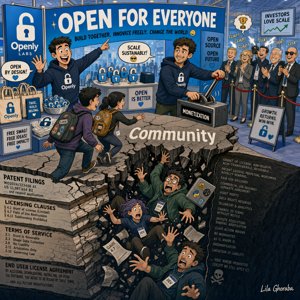
The cartoon targets performative openness in tech: companies market themselves as community-friendly and accessible, but use legal and financial mechanisms to convert shared participation into private control once value appears.
by Lila Ghoraba
 Technology
Open Office, Closed Future
The cartoon mocks tech companies that market themselves as champions of openness, collaboration, and the public good while aggressively locking down data, models, and methods the moment real access is at stake. Their openness is architectural and aesthetic, not substantive.
by Lila Ghoraba