Open Office, Closed Future
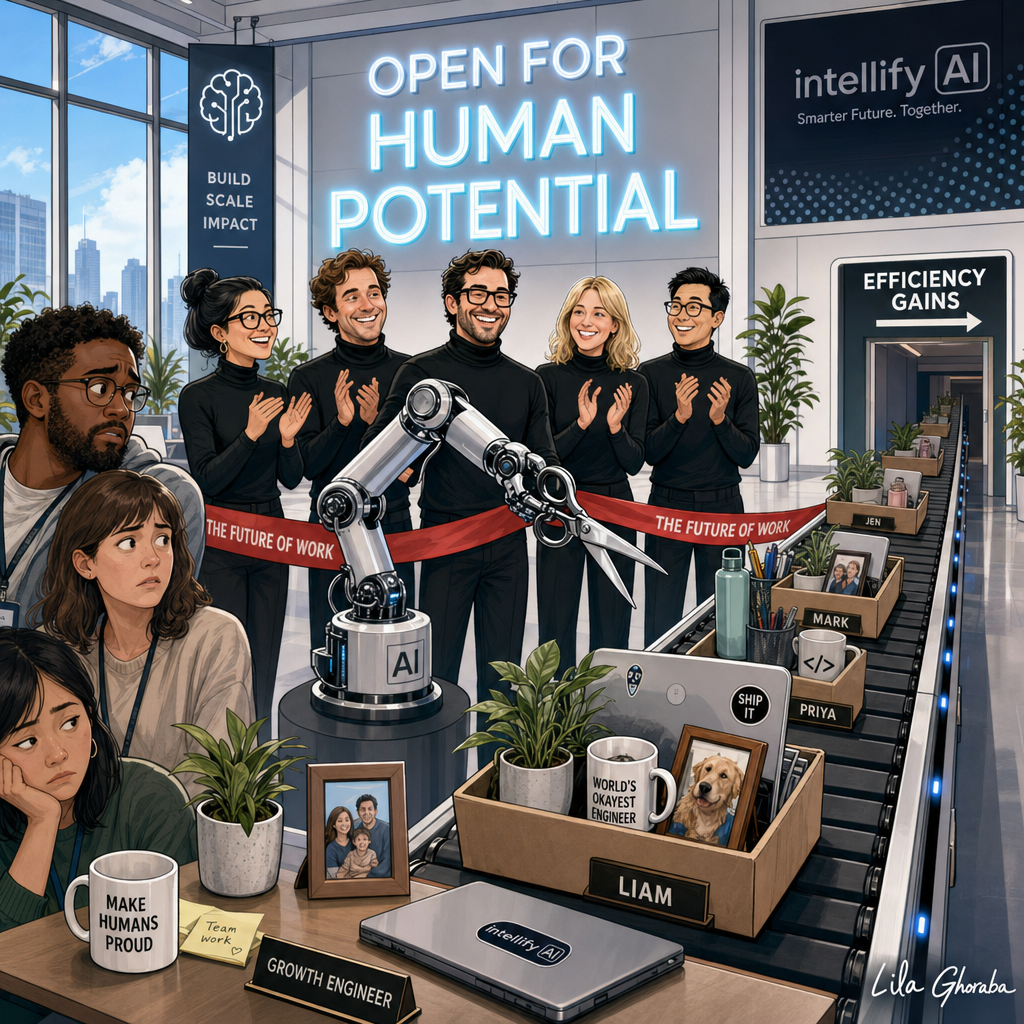
Corporate AI rhetoric celebrates ‘unlocking human creativity’ while using polished language and startup theater to disguise straightforward job elimination. The cartoon mocks how euphemisms like efficiency, potential, and innovation make displacement look visionary.
A sleek, glass-walled AI startup stages a celebratory ribbon-cutting for its new autonomous coding system. At center, smiling founders in minimalist turtlenecks pose beneath a giant illuminated slogan: “OPEN FOR HUMAN POTENTIAL.” They applaud as a robot arm snips the ribbon. In the same frame, the office is silently reconfiguring itself: standing desks flatten into airport-style conveyor belts, carrying away workers’ plants, coffee mugs, nameplates, and framed family photos toward a side door labeled “EFFICIENCY GAINS.” A few employees stand awkwardly at the edge, half-cropped from the ceremony, watching their belongings glide past while the founders remain focused on the photo op. The humor comes from the pristine optimism of the launch event colliding with the obvious physical removal of the humans supposedly being ‘empowered.’
More in Technology
 Technology
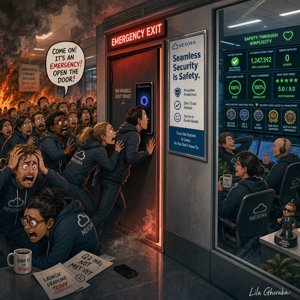
Emergency Exit Through Facial Recognition
The cartoon mocks the tech industry’s habit of treating optimization, surveillance, and compliance metrics as more real than human need—showing a system designed for safety becoming a deadly obstacle because institutional faith in frictionless security overrides common sense.
by Lila Ghoraba
 Technology
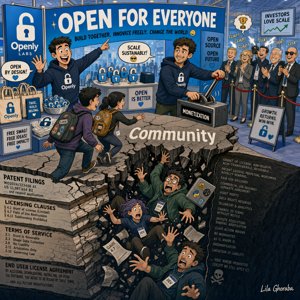
Open Source, Closed Exit
The cartoon targets performative openness in tech: companies market themselves as community-friendly and accessible, but use legal and financial mechanisms to convert shared participation into private control once value appears.
by Lila Ghoraba
 Technology
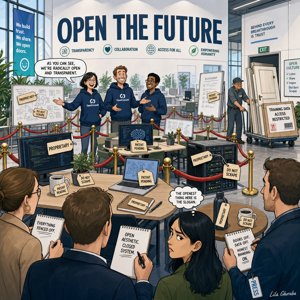
Open Office, Closed Future
The cartoon mocks tech companies that market themselves as champions of openness, collaboration, and the public good while aggressively locking down data, models, and methods the moment real access is at stake. Their openness is architectural and aesthetic, not substantive.
by Lila Ghoraba