Open Source, Closed Exit
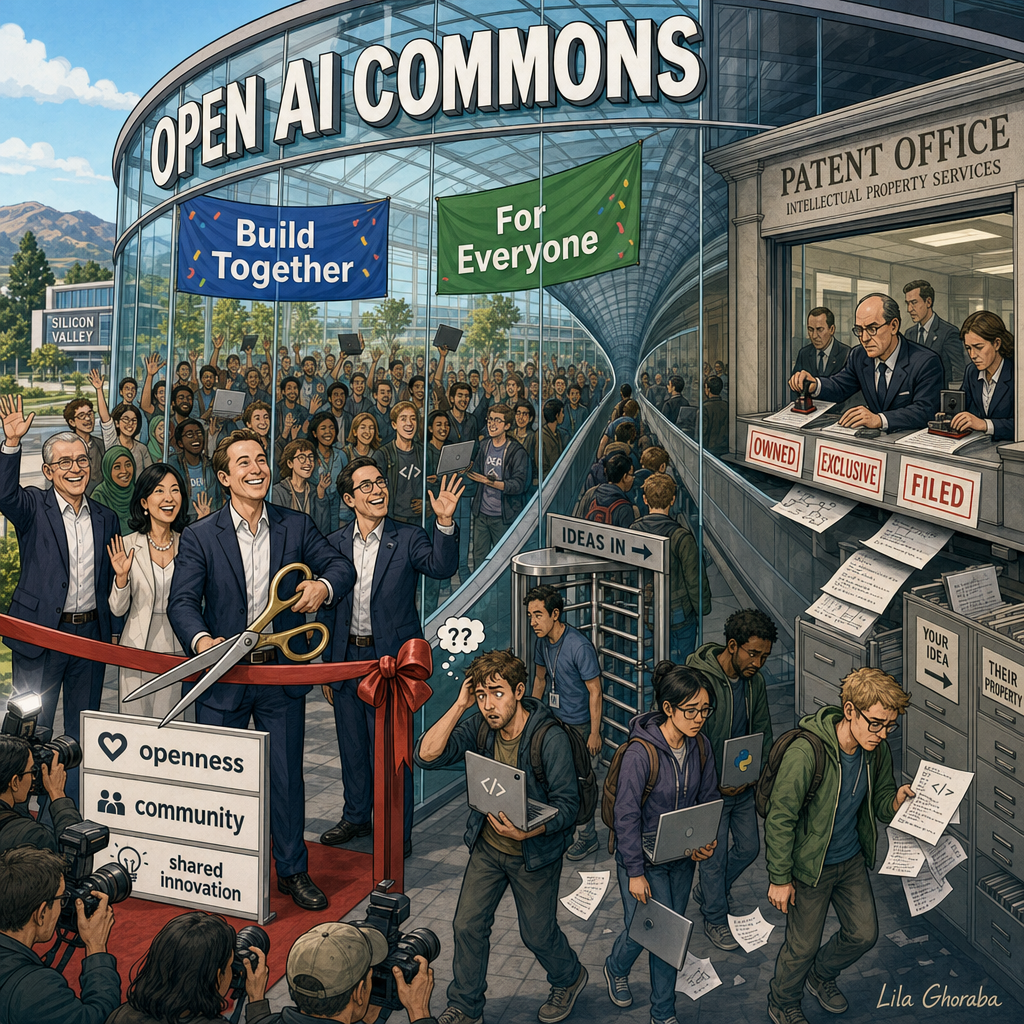
The cartoon mocks corporate "open" initiatives that welcome public creativity and collaboration only to channel the resulting value into proprietary control. It targets the gap between the branding of openness as civic-minded generosity and the underlying extraction of community labor into private i
A polished Silicon Valley campus hosts a festive ribbon-cutting for a vast glass atrium labeled "OPEN AI COMMONS." Smiling executives with oversized ceremonial scissors wave a crowd of eager developers inside beneath banners reading "Build Together" and "For Everyone." Through the transparent walls, the viewer can see the building’s interior subtly narrowing like a funnel. At the far end, the only exit is a cramped metal turnstile that feeds directly into a patent office service window, where stone-faced lawyers and clerks rapidly stamp documents marked "Owned," "Exclusive," and "Filed." Developers emerge from the turnstile looking confused, clutching empty laptops or loose code snippets while their ideas slide under the window into filing cabinets. The executives outside keep posing for cameras beside words like "openness," "community," and "shared innovation," ignoring the ownership machinery plainly visible through the glass.
More in Technology
 Technology
Emergency Exit Through Facial Recognition
The cartoon mocks the tech industry’s habit of treating optimization, surveillance, and compliance metrics as more real than human need—showing a system designed for safety becoming a deadly obstacle because institutional faith in frictionless security overrides common sense.
by Lila Ghoraba
 Technology
Open Source, Closed Exit
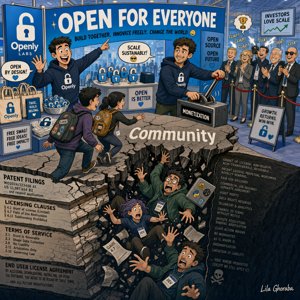
The cartoon targets performative openness in tech: companies market themselves as community-friendly and accessible, but use legal and financial mechanisms to convert shared participation into private control once value appears.
by Lila Ghoraba
 Technology
Open Office, Closed Future
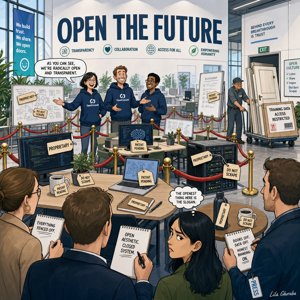
The cartoon mocks tech companies that market themselves as champions of openness, collaboration, and the public good while aggressively locking down data, models, and methods the moment real access is at stake. Their openness is architectural and aesthetic, not substantive.
by Lila Ghoraba