Open Source, Closed Door
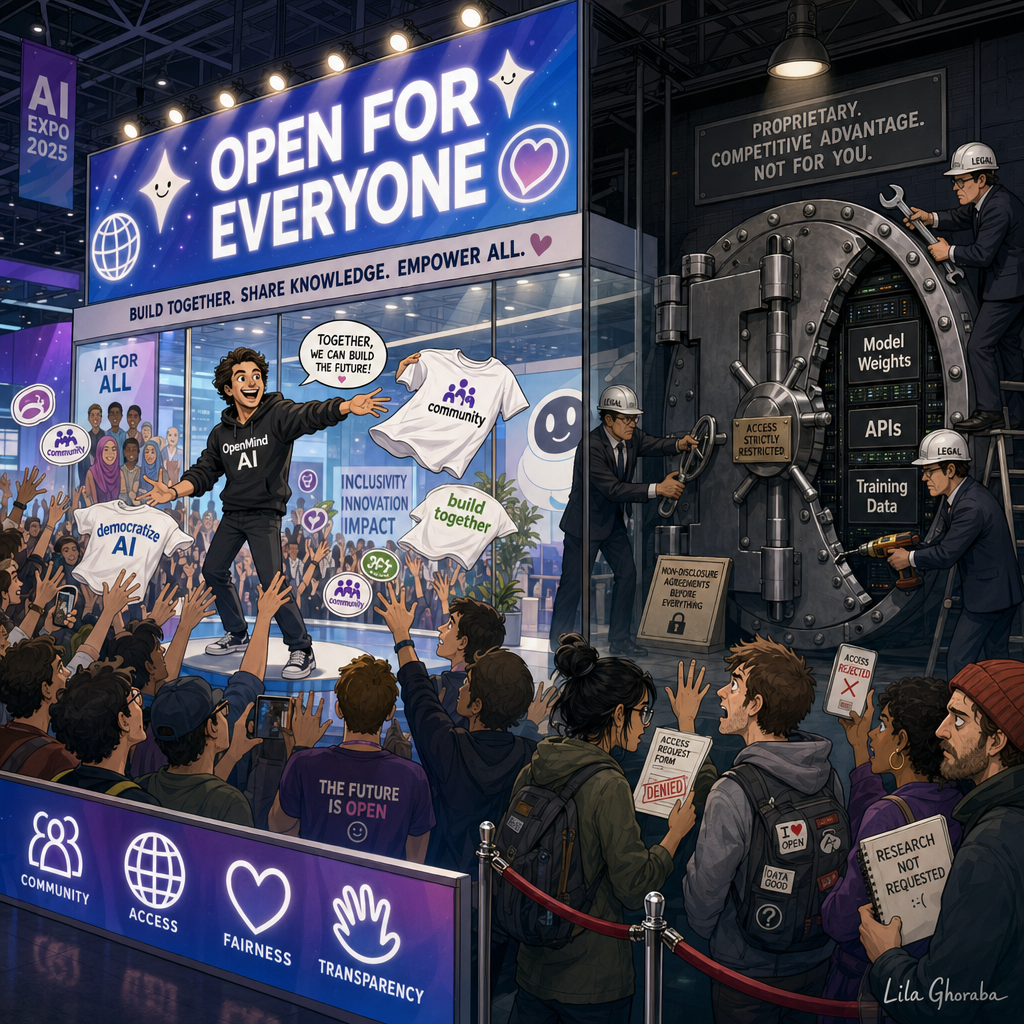
The cartoon mocks performative openness in AI: companies market the language and aesthetics of open source to harvest goodwill, talent, and moral credibility, while keeping the valuable core assets tightly locked behind legal, technical, and commercial barriers.
At a sleek AI expo booth styled like a revival tent, a charismatic founder stands under a giant glowing banner that says "OPEN FOR EVERYONE," beaming as they toss branded T-shirts and stickers labeled "community," "democratize AI," and "build together" into a jubilant crowd. The front of the booth is all glass, light, and inclusivity messaging. But in the shadowy backstage area, company lawyers in suits and hard hats are bolting an enormous bank-vault door over a server rack clearly labeled "Model Weights," "APIs," and "Training Data." Outside that sealed chamber, a handful of indie developers and researchers peer in from behind a velvet rope, pressing their faces to the glass and clutching laptops, access requests, and rejected keycards. The founder’s public performance and the backstage lockup happen in the same frame, making the contradiction impossible to miss.
More in Technology
 Technology
Emergency Exit Through Facial Recognition
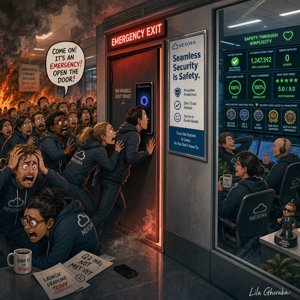
The cartoon mocks the tech industry’s habit of treating optimization, surveillance, and compliance metrics as more real than human need—showing a system designed for safety becoming a deadly obstacle because institutional faith in frictionless security overrides common sense.
by Lila Ghoraba
 Technology
Open Source, Closed Exit
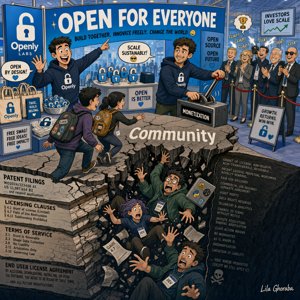
The cartoon targets performative openness in tech: companies market themselves as community-friendly and accessible, but use legal and financial mechanisms to convert shared participation into private control once value appears.
by Lila Ghoraba
 Technology
Open Office, Closed Future
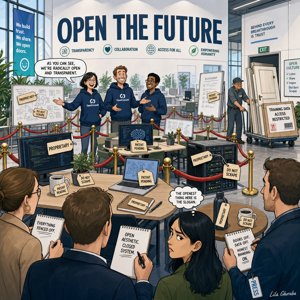
The cartoon mocks tech companies that market themselves as champions of openness, collaboration, and the public good while aggressively locking down data, models, and methods the moment real access is at stake. Their openness is architectural and aesthetic, not substantive.
by Lila Ghoraba