Open Source, Closed Exits
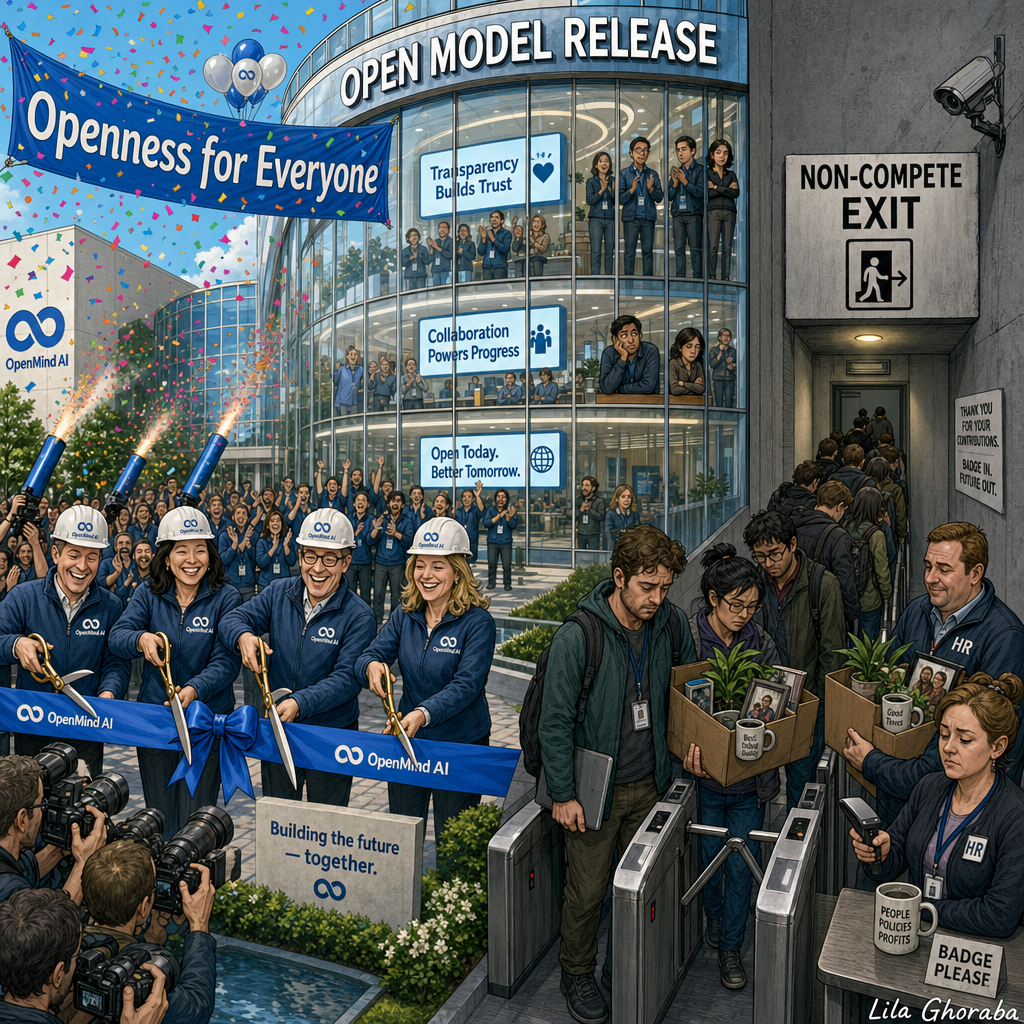
The cartoon mocks corporate hypocrisy in the AI industry: companies loudly market themselves as champions of openness, sharing, and innovation, while simultaneously restricting, discarding, or legally trapping the very people who created the technology. It satirizes 'open' as a PR label for products
A single-panel cartoon set on the pristine campus of a flashy AI firm during a celebratory product launch. In the foreground, executives in branded fleeces and hard hats beam as they cut a giant ribbon across the entrance of an enormous glass building labeled OPEN MODEL RELEASE. Confetti cannons, cameras, and a banner reading 'Openness for Everyone' heighten the spectacle. In the same frame, just off to the side but impossible to miss, a line of weary engineers and researchers are being herded through airport-style turnstiles toward a cramped side door labeled NON-COMPETE EXIT. An HR rep collects badges while another carries a box of desk plants and family photos. Through the giant windows of the open-release building, presentation screens show slogans about transparency and collaboration, while some employees inside are applauding the launch and others glance nervously toward the exit line. The humor comes from the stark architectural contrast: openness gets a palace, workers get a chute.
More in Technology
 Technology
Emergency Exit Through Facial Recognition
The cartoon mocks the tech industry’s habit of treating optimization, surveillance, and compliance metrics as more real than human need—showing a system designed for safety becoming a deadly obstacle because institutional faith in frictionless security overrides common sense.
by Lila Ghoraba
 Technology
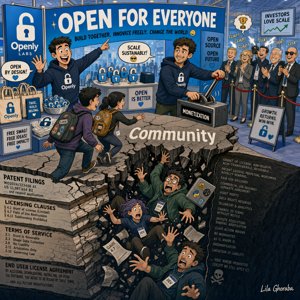
Open Source, Closed Exit
The cartoon targets performative openness in tech: companies market themselves as community-friendly and accessible, but use legal and financial mechanisms to convert shared participation into private control once value appears.
by Lila Ghoraba
 Technology
Open Office, Closed Future
The cartoon mocks tech companies that market themselves as champions of openness, collaboration, and the public good while aggressively locking down data, models, and methods the moment real access is at stake. Their openness is architectural and aesthetic, not substantive.
by Lila Ghoraba