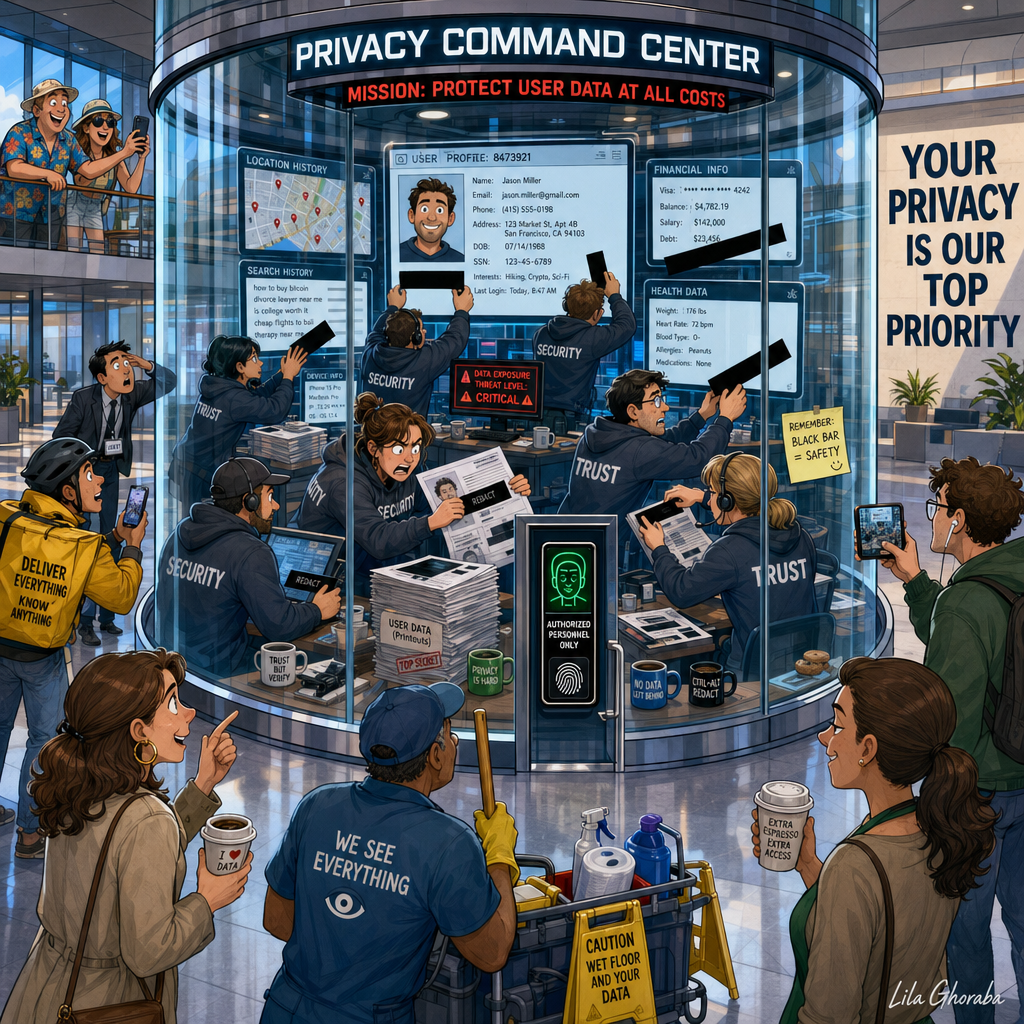
Privacy Team's Glass War Room
The cartoon mocks corporate privacy theater: companies that perform meticulous, high-drama concern for user data while designing systems, policies, or business models that expose that same data in plain sight. It satirizes optics over substance—security as branding rather than actual protection.
A sleek, futuristic 'Privacy Command Center' sits at the center of a tech campus lobby like a fishbowl: floor-to-ceiling glass walls, glowing dashboards, and a tense team in SECURITY and TRUST hoodies clustered around giant monitors. Inside, they are frantically blacking out names, faces, and personal details with oversized digital redaction bars, treating the task like a military operation. Yet the joke is instantly visible: because the room is entirely transparent, everyone outside—delivery couriers, office guests, janitors, tourists taking selfies, even a barista passing by—can clearly see the supposedly protected, fully unredacted information from the sides and reflections. Add little touches like a wall slogan reading 'YOUR PRIVACY IS OUR TOP PRIORITY' and perhaps a biometric lock on the glass door to heighten the contradiction.
More in Technology
 Technology
Emergency Exit Through Facial Recognition
The cartoon mocks the tech industry’s habit of treating optimization, surveillance, and compliance metrics as more real than human need—showing a system designed for safety becoming a deadly obstacle because institutional faith in frictionless security overrides common sense.
by Lila Ghoraba
 Technology
Open Source, Closed Exit
The cartoon targets performative openness in tech: companies market themselves as community-friendly and accessible, but use legal and financial mechanisms to convert shared participation into private control once value appears.
by Lila Ghoraba
 Technology
Open Office, Closed Future
The cartoon mocks tech companies that market themselves as champions of openness, collaboration, and the public good while aggressively locking down data, models, and methods the moment real access is at stake. Their openness is architectural and aesthetic, not substantive.
by Lila Ghoraba