Green AI, Red Gauge
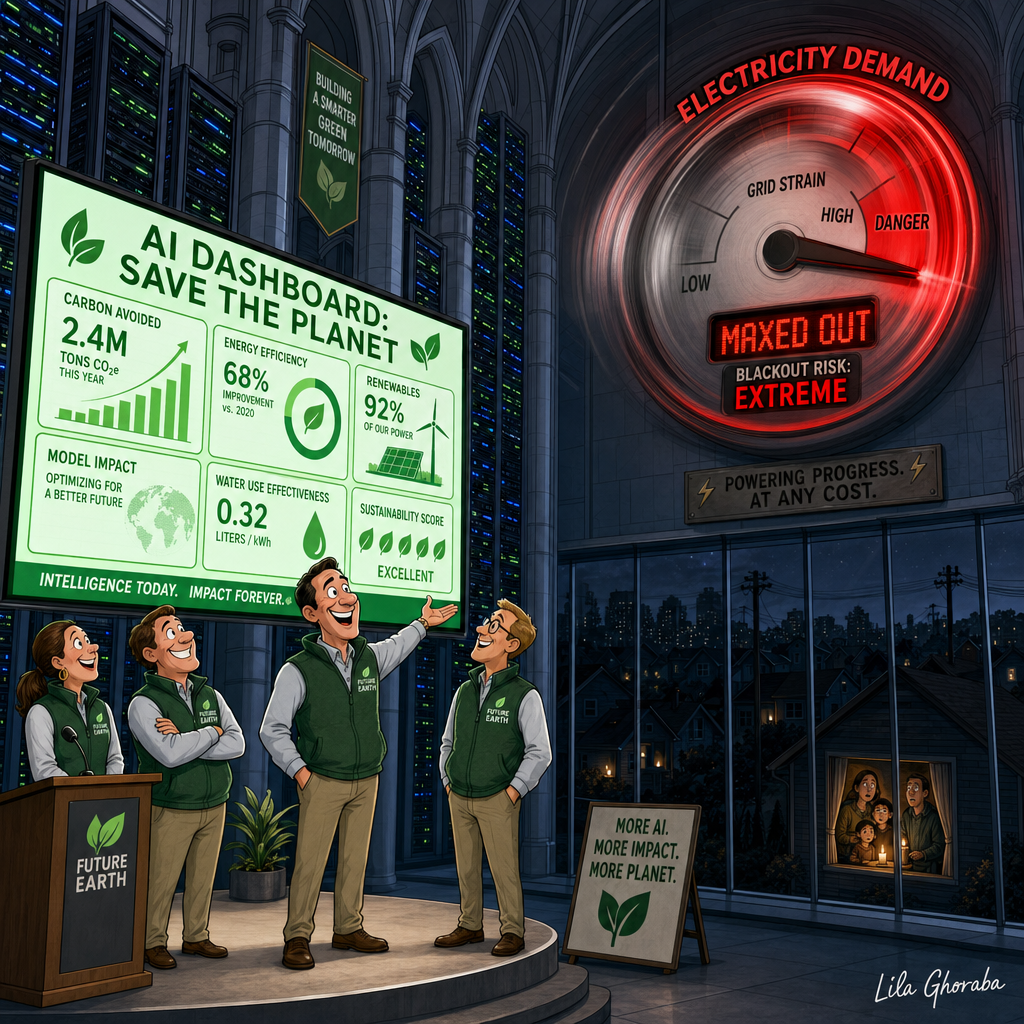
The cartoon mocks techno-solutionist hypocrisy: elites celebrating AI as a climate savior while its ravenous energy appetite worsens the very infrastructure and sustainability problems they claim to solve. The joke is that the 'green' story exists only on the dashboard, while the grid itself is flas
A single-panel cartoon set inside a cathedral-like hyperscale data center. In the foreground, smiling climate-tech executives in matching fleece vests stand on a small presentation stage beside a glowing screen that reads: “AI DASHBOARD: SAVE THE PLANET.” One executive gestures proudly at cheerful green charts, leaf icons, and efficiency badges. But dominating the background is a gigantic wall-mounted electricity meter or demand gauge, glowing alarm-red and spinning so violently it’s blurred, with the needle buried in the danger zone. Through a floor-to-ceiling glass wall behind them, a nearby residential neighborhood is visible in darkness during a rolling blackout: silhouettes of houses, a few windows lit by candles, maybe one family peering out. The executives remain oblivious, basking in the green glow of their presentation while the real-world cost is literally visible behind them.
More in Technology
 Technology
Emergency Exit Through Facial Recognition
The cartoon mocks the tech industry’s habit of treating optimization, surveillance, and compliance metrics as more real than human need—showing a system designed for safety becoming a deadly obstacle because institutional faith in frictionless security overrides common sense.
by Lila Ghoraba
 Technology
Open Source, Closed Exit
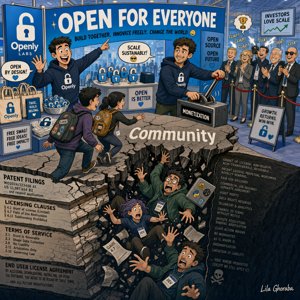
The cartoon targets performative openness in tech: companies market themselves as community-friendly and accessible, but use legal and financial mechanisms to convert shared participation into private control once value appears.
by Lila Ghoraba
 Technology
Open Office, Closed Future
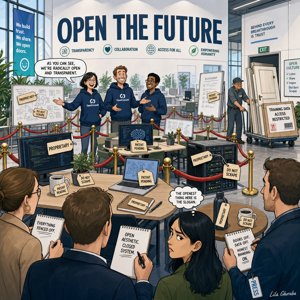
The cartoon mocks tech companies that market themselves as champions of openness, collaboration, and the public good while aggressively locking down data, models, and methods the moment real access is at stake. Their openness is architectural and aesthetic, not substantive.
by Lila Ghoraba